
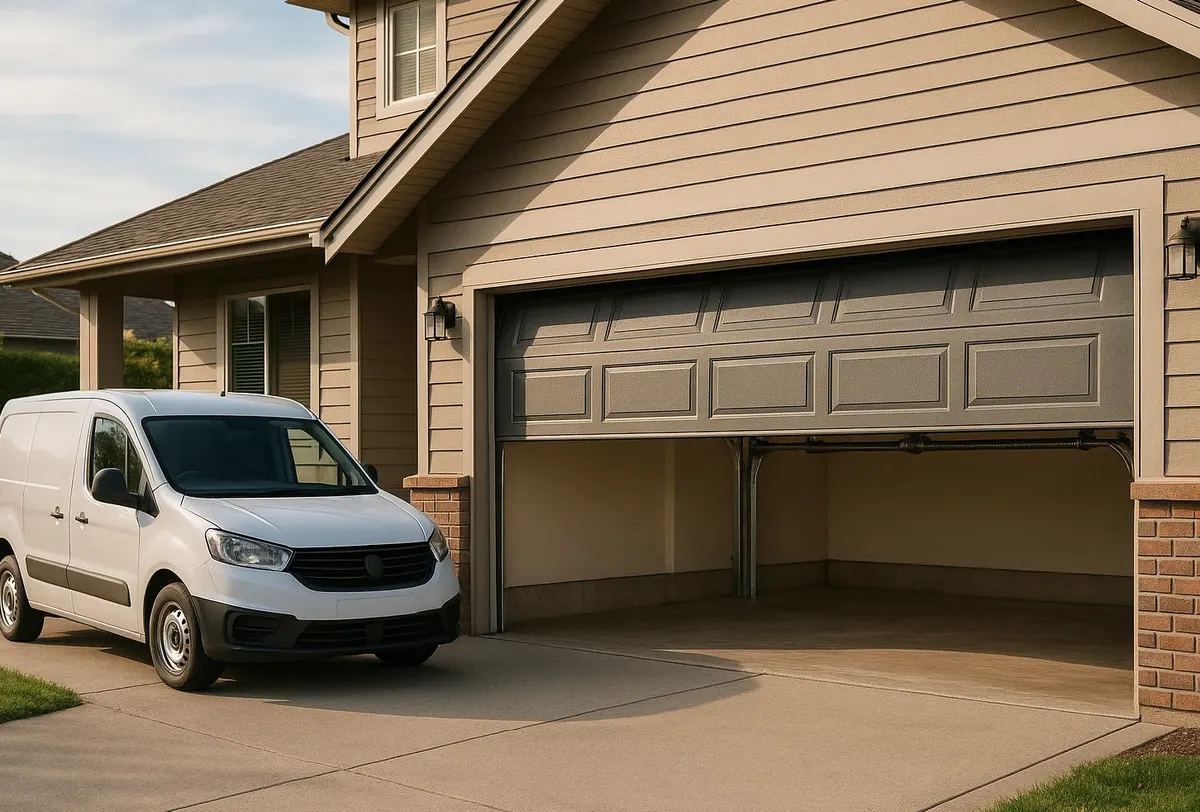
What the Call Usually Looks Like
The pattern is almost always the same. A homeowner comes out in the morning, finds the garage door standing open an inch or two, and calls thinking something's broken. Nothing mechanical failed. When a technician gets there, the emergency release cord is swinging loose, the weatherstripping along the top is peeled back, and there's a thin scuff mark on the inside of the door where a wire was fed through. Nothing was taken from inside the garage that time, but the bikes were gone, or the door into the house was left unlocked because "it's just the garage." In other cases, the call comes in because the door won't move at all afterward — the bottom bracket is bent, the roller is popped out of the track, and there's a fresh gouge from a pry bar near the lock. Either way, the damage usually isn't the point. The point is that the garage door was the easiest way into the house, not the family room window.
The Few Ways Garage Doors Actually Get Breached
Despite how it sounds in movies, break-ins through garage doors rely on a handful of repeatable tricks, not brute force:
- The coat-hanger trick: A wire is fed through the small gap at the top of the door and hooked around the emergency release cord, popping the door into manual mode so it can be lifted by hand. This works on almost any door that doesn't have a shield over the release.
- Prying the bottom corner: A flat bar is wedged under the bottom corner and the door is pried enough to pop the roller from the track, especially on older doors with worn or undersized brackets.
- Code grabbing on old openers: Openers from the 1990s and earlier used fixed codes that can be captured and replayed with cheap, widely available devices. If your opener still uses a dip-switch code instead of rolling code, it's a real exposure, not a theoretical one.
- Garage windows: If the door has glass panels, a punched-out pane gives direct access to the wall button or the emergency release, no finesse required.
- Simple distraction: The door gets left open during unloading groceries, yard work, or waiting out a rain shower, and that's the whole method. No tool needed.
Hardware That Actually Closes These Gaps
Each of the methods above has a direct hardware fix, and most are inexpensive relative to the risk:
- Emergency release shield: A simple plastic or metal cover that blocks a wire from reaching the release cord from outside. This alone stops the most common method cold.
- Reinforced bottom brackets and tracks: The same upgrade used for earthquake retrofitting — heavier gauge brackets lag-bolted into the framing instead of thin stock screwed into drywall — also resists prying far better. If your door hasn't had its brackets checked in years, this is worth doing in one visit.
- Rolling-code opener: If the opener predates the early 2000s, replacing it removes the code-grabbing risk entirely and usually comes with a battery backup, which also matters here given winter storm outages.
- Frosted or covered garage windows: Privacy film or interior covering removes the easy visual and physical access point without blocking all light.
- Slide bolt or manual lock for service doors: If there's a side door into the garage, it needs its own deadbolt — a forced garage door is sometimes just a backup plan when the side door was never locked at all.
Habits That Hardware Can't Fix
Hardware stops tools; habits stop opportunity. A few things worth making automatic: never leave a remote in a car parked in the driveway or on the street — it's a spare key to the house, not just the garage. Close the door fully before walking inside with groceries, even for sixty seconds. Don't leave the garage open "for air" during the dry season or to vent dust — it's an open invitation during exactly the stretch when people are outside less and watching less. If the coastal salt air has been quietly corroding hinges, lock cylinders, or brackets, that weakened hardware fails faster under a pry bar than it would inland, so homes closer to the water benefit from checking these parts more often, not less.
When to Call Westminster Garage Door Pro
If your opener still uses an old fixed-code remote, your emergency release has no shield, or a recent inspection turned up corroded brackets or a loose track, it's worth having it looked at before it becomes an entry point instead of an inconvenience. Westminster Garage Door Pro can handle a garage door opener repair & installation to move you onto rolling code and battery backup, and a garage door maintenance visit to check brackets, tracks, and hardware for wear before it becomes a weak spot. If something's already been tampered with or damaged, same-day and emergency garage door service means it doesn't sit vulnerable overnight.
If any of this sounds familiar — a loose release cord, an opener older than your car, windows in the door facing the street — call Westminster Garage Door Pro for a straightforward inspection and the fixes that actually matter for homes in Westminster, CA.